Showing posts with label Chem 173. Show all posts

Monday, March 12, 2012

My Motivation and Inspiration


The most astounding fact about the universe is talked about here. This video is so beautifully done, the videos, animation, photography, music, and narration are all done perfectly in my opinion and all of those qualities are what make this such an inspiring video. I don't even know what it inspires me to do it just makes me happy and is so moving that it shocks me, and makes me want to be a better person.


This next video is what motivates me. First of all, boxing is one of my favorite ways to stay in shape. I would like to be able to fight but I am not allowed to so for now I can only train. This video motivates me to hit the bags every chance I get. If this guy can transform himself into a fighter without even having a bed to sleep in, then I should be able to fight too.


Monday, March 5, 2012

Life Heals... Now, So Do Hydrogels

Something that scientists have been trying to replicate for years is a living thing's ability to heal itself and thus sustain repeated damage. Now, thanks to bioengineers at the University of California there is a jello like substance that reforms after being pulled apart. The substance is called Hydrogel and thanks to its high water content it is able to mimic flexibility and other textural qualities of biological matter.


Hydrogels are semi-solid, gummy-bear-like squishy materials made of chains of hydrophilic polymer molecules. Hydrophilic polymers contain polar functional groups which makes them water soluble. 
The hydrophilic quality makes them a good analog for natural tissues so they often have medical applications.
One use of hydrogel shown here is scar reduction.
http://www.tapemark.com/Side%20photos/Hydrogel-g.jpg

The team at the University of California realized that the key to making the hydrogels self heal was giving the polymer chains a way to latch back on to each other if ripped apart or damaged. The solution is what they call "dangling side chains". They are finger like structures of hydrophilic polymer that reach off the main structure of polymers and act as something to grab on to. Another posotive trait of the self healing gel is that when pH of the solution it is in is lower, the bond becomes stronger between polymers. This will be ideal for suturing in the stomach, or creating containers for holding acidic materials.

The video below shows and explains how two pieces of the gel, when split apart, can put themselves back together with a little help. Enjoy.

Tuesday, February 28, 2012

A Less Sci-Fi Based Weapon of the Future

The last time I made a blog post I talked about how the laser should be the weapon of the future. It is not wasting a projectile or using dangerous chemicals (gunpoweder) to propell it, but is just energy. I still stand by what I said, however, it is not yet completely within our grasp to be able to not fire a projectile at the enemy. That is why I want to tweek what I said last week by adding that the laser is the weapon of the distant future. A weapon that I am seeing as being part of the near future is the Electromagnetic Railgun.
http://www.popsci.com/files/imagecache/article_image_large/articles/tech0604magnet_730x550.jpg
The railgun is futuristic because it does not use chemicals as its propellant, but instead uses electricity. The reason it is just futuristic enough to be in the near future (in my opinion) is that it still fires a projectile. According to Popular Science, the U.S Navy recently put a prototype of a 32 megajoule railgun through some tests and it completed the tests surprisingly well. The Navy's futuristic weapon is capable of firing a large metal projectile at speeds of 5,600 mph and someday its makers think that when attatched to battleships it will be able to fire the projectile 50 to 100 nautical miles. Where does this energy come from? Well its in the name, 32 MEGAJOULES IS A LOT OF ENERGY. To put it in perspective, 1 megajoule is equivalent to a 1,000 pound car thrust at 100 mph. Multiply that by 32 and you have got a stupid amount of energy!!!
One of the railguns being tested
http://upload.wikimedia.org/wikipedia/commons/f/f2/US_Navy_071128-N-7676W-101_The_Office_of_Naval_Research_32_MJ_(megajoules)_Electromagnetic_Railgun_(EMRG)_laboratory_launcher,_located_on_board_the_Naval_Surface_Warfare_Center_Dahlgren_Division,_is_operational.jpg
How do these work? Two long, conductive rods are laid down parallel to eachother. An armature, or a solid piece of conductive metal bridges the gap between the two rods. A current is run through the positive rod and the current goes up the rod, across the armature, down the negative rod and back into the power source. A magnetic field forms around each rod, around the positive rod it spins counter clockwise and around the negative rod it spins clockwise. A projectile which is laid inbetween the two rods experiances a force called the Lorentz force which runs perpendicular to the magnetic field and in the direction of the armature.
http://static.ddmcdn.com/gif/railgun-7.gifThe railgun is powerful but it requires a lot of energy to shoot a projectile.

Above are two videos displaying the power of the prototype railgun. Clearly, this weapon has a lot of potential if it is firing chunks of metal that big, that fast, without dangerous chemicals. My question is will this weapon pass all of its tests and eventually be implemented on to the battleships and maybe even planes of the U.S Navy and Airforce? Or should the Defense branaches of the U.S Army stick with the dangerous chemically powered weapons that have brought our so far?

Monday, February 20, 2012

The Laser is the Weapon of the Future

If you ask me, I say that weapons these days are inefficient. If we are talking about missiles, each costs more than a mini-van and it only works one time. The problem I have with that is, the missile is weighing down the jets that carry it thousands of miles (sometimes) just to be fired once. Although missile technology has gotten far more deadly, they still won’t always hit their target and do their job.


Missiles are not the only inefficient killing device that our world has come to use. Guns, and more specifically bullets, are even more inefficient that missiles because one missile can kill many bad guys who are spread out over a larger area. A bullet is lucky to hit one man, and the further away from the target that the bullet is fired, the less chance it has to kill. A missile can be fired from a distance that is great enough to keep the person firing it safe, while effectively killing or injuring the enemy.


 I like the saying from the movie Iron Man which was something like, “I prefer the weapon that you only have to fire once.” However, even this saying I have a bit of an issue with because it isn’t clear who should be killed in that one firing. I would improve that saying by adding that you only have to fire it once to kill all the bad guys, or targets you want.

Cool clip from Iron Man^^


I want to focus more on guns and how I would improve them because my knowledge of missiles is less than my knowledge of guns. Guns have huge kickback, they jam easily, must be cleaned, they are only useful if being wielded by an accurate shooter, they can backfire, and they have a limited amount of ammunition. The limited ammunition is my biggest issue with weapons these days. If a soldier runs out of bullets he has lost his best chance at killing, and his best form of protection. So what could we do to make bullets obsolete, and make guns more deadly?

LASER GUNS! Why not go in the science fiction direction? Laser technology is already at a place where lasers can be fired from planes that have controlled amounts of power from lethal to nonlethal. Another advantage is that they can be precisely targeted, and since the lasers are beams of high energy light they travel at the speed of light. Lasers are also silent, unlike the way they are portrayed in movies. So, when fired they would not give away a soldiers position.

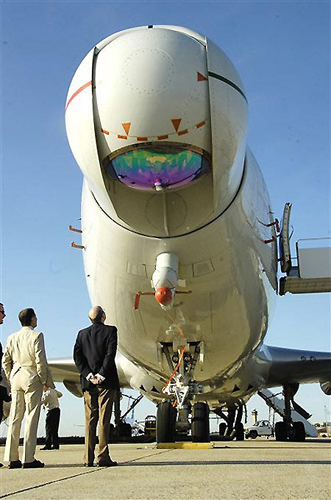
http://realitypod.com/wp-content/uploads/2010/07/airborne_77_laser_weapon_system.jpg

Here is an image of an airborne laser. This airborne laser is capable of locating in flight missiles and shooting high energy lasers at the missile which cause it to explode. I believe, that like all other technology it will get smaller and smaller until it is capable of being held by one man and fired to kill or stun or even injure another man.


Monday, January 2, 2012

Why Do Clouds Form Around Fast Flying Jets?


Breaking the Sound Barrier
http://i.telegraph.co.uk/multimedia/archive/01410/hornet_1410652c.jpg


The capabilities of fighter jets these days are awesome. Breaking the sound barrier seems easily achieved for many fighter jets. However, these days the military seems to be making more stealth planes/bombers and those cannot break the sound barrier because the sonic boom would defeat their purpose. Sound travels at about 760 mph. When a plane goes that fast it causes both visual and audible effects. There is one effect that I want to focus on; that skirt of water vapor that forms around the tail end of the jet in the picture. Why does this happen? When a jet goes that fast it is pushing the air around it away and creating more pressure in certain areas around the plane. 

http://www.nasa.gov/images/content/185591main_f-516.jpg

In this picture of a bullet traveling at high speeds, you can see the bends that the bullet is causing. As the bullet travels quickly it pushes the air in front of it out of the way. Pushing the air causes more air to be around the sides of the bullet. The same happens to a jet. Since jets are so large, when they create pressure waves they are condensing a lot more air in a given place than a bullet can. So, if the air in which the plane is flying is very moist, the moisture is condensed under the pressure of the air. The plane forms enough pressure that the water condenses into a temporary cloud around the area where the pressure is high enough to condense the water. I say temporary, because the cloud is only forming because of the intense air pressure caused by the jet traveling at very high speeds. The cloud forms, dissipates and reforms which makes it look like its moving as the plane moves. As soon as the plane’s speed drops below the sound barrier it does not create enough pressure in the air to condense water so the cloud would no longer be visible.

This image depicts the pressure wave well, calling it a shock wave which is similar to a pressure wave. As you can see in the picture a cone shape forms as the plane flies. At low altitudes, the air is filled with water vapor from evaporation, humans breathing, sweating, plants giving off water and so on. In previous blog posts I explained how cars could run on water in the future. If there is water in the air, could we use that for energy? Someday, could planes run on the moisture of the air?!

Thursday, December 8, 2011

Don't Pee In Your Gas Tank...Yet

This summer, I think I am going to build a welding torch. Not just any old oxy-acetylene, ARC, or MIG welding torch though. I am going to build a welding torch that’s fuel is water. Think about my last post, when I said that hydrogen and oxygen, the two elements that make up water are so flammable that they are sometimes used in rocket ships. In rocket ships the hydrogen and oxygen are used in liquid form which requires a lot of chemicals to keep them in that state, it is very dangerous because one spark and its Apollo 13 all over again, and you need high pressure tanks to hold them. To be safer and smarter, I plan to make the hydrogen and oxygen from water, so the two elements are delivered to the nozzle of the welding torch as a gas. This is no easy task, splitting water molecules, because hydrogen and oxygen are covalently bonded.


So, how could you break the strong bonds of the hydrogen to the oxygen? Give it a lot of energy. The electron of hydrogen is shared with oxygen and doesn’t have enough energy to escape from the oxygen. So, if enough energy is transferred into the water molecule it will excite the electrons enough to allow the hydrogen to yank itself free from the overwhelming attraction to oxygen. Then you have got 2 elements, perfect for welding. The process of splitting water using electricity (the energy) is called electrolysis.


http://www.nmsea.org/Curriculum/7_12/electrolysis/electrolysis_chemistry.gif

http://www.youtube.com/watch?v=320b9NGiFU0
Awesome video of a homemade HHO welding torch

This shows the power of the flame that is created when hydrogen and oxygen react. The Dr. Pepper can was in front of the flame for a few seconds and a slit was melted in its side easily. The energy from the reaction should be harnessed and like I mentioned in my last post, I think it should be used to power cars. The coolest part about a water powered car or any HHO flame for that matter is that its only emission is be water vapor.
Only emitting water vapor is truly awesome compared to the crap that comes out of car's tale pipes these days. In a water powered car, if you could find a way to loop the exhaust pipe back into the water tank in a safe way, the car would make one tank of water last a long time by recycling its exhaust. There is one huge problem, it takes a substantial amount of energy to break the bonds of hydrogen and oxygen, so much energy that any resulting energy you would get from recombining them would be less then what it took to split them.
In a recent discovery inventor Denny Klein found a way to perform electrolysis in a way that would use less energy. Here’s a video clip on the new discovery.  

In that video, listen closely if you missed it just after 1:30…
You can hear the inventor clearly say that a 100 mile trip uses about 4 OUNCES of water! 128 fluid ounces = 1 fluid gallon. According to that conversion factor you would get aproximately 3200 miles out of one gallon of water. This discovery is truly revolutionary and could really change the world if we use it correctly.
Some draw backs could be that we might find ourselves running low on water because if this technology catches on, cars all over the world would be using up fresh water and that would leave us pretty thirsty.

Sitting on my couch thinking of ways that we could make water a priority for Mankind first, cars second, I found a creative solution to the problem. I remembered that NASA uses a technology to convert urine into drinking water.

 The link to the news article on Nasa’s Urine to water filter.
 I understand if you're skeptical here because it does sound gross that astronauts are drinking their own pee. However, if you think about it, urine is nothing more than water with some nitrogenous waste, salts, and other dead cells and waste that the body is getting rid of by filtering them out in the kidneys. So, since NASA has found a way to filter out the unwanted molecules, all they have to do now is install one into the opening of the gas tank of the water powered car so that all pee or water passing through could be filtered. I am suggesting that cars run on urine, a very environmentally friendly idea. If the water powered car idea catches on quickly enough my future kids could be peeing into the gas tank if they’re running low on water! Then the only problem we would be dealing with would be where to dumb the excess of filtered waste coming from the pee.

Maybe homes could have a designated toilet for urinating where the waste could be flushed with small amounts of toilet water and stored under the garage so that all homes could have a fuel pump in their garage. That waste could even be filtered in the toilet and turned into pure water so that the car wouldn’t have to waste energy on filtering the urine.

Image Left
Image Right

With an in home pump, people wouldn’t have to pee in public. But, I think that the car should have a urine-to-water filter just in case you run out of gas in the middle of nowhere and need a few more miles out of your thirsty old car.


Sunday, December 4, 2011

Water Just Does Not Want To Burn

Since I was about four years old and first started to play with matches I have been a pyromaniac. Not a crazy one who burns down buildings but more of a scientific pyromaniac who builds foundries and smelters and just enjoys a good backyard bonfire.

When I first started being interested in fire I could never understand why water isn’t flammable. I put flaming matches, candles and pieces of paper into buckets of water and over many trials I found the data to be conclusive: water definitely isn’t flammable. At that time I was only curious because everything else seemed to be pretty flammable but water was the only thing I tried to light that didn’t catch or even blacken in the flame.


As I got older and learned that water was made of Hydrogen and Oxygen, the fact that water wouldn’t catch flame made even less sense to me.
(Red are oxygen white are hydrogen)

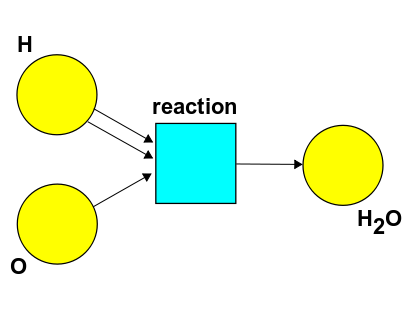
Now that I am in high school Chemistry I know that Oxygen has 6 valence electrons and Hydrogen has 1, so two Hydrogen atoms want to bond with an Oxygen atom to reach a stable octet: when there are 8 valence electrons. If not bonded Hydrogen and Oxygen together are flammable…very very very flammable… As in flammable enough to be the fuel for some rocket ships.


(Image Left)
( Image Right)

The way I think of it is that the statement, “if not bonded Hydrogen and Oxygen together are flammable” gives away the reason why water isn’t flammable. Water is the product of hydrogen and oxygen burning. Try sticking a match into a pile of dry ash and it will go out. Stick a match into water and it will go out. Water is basically ash! It is the product of burning so it cannot burn more and more importantly it has reached a stable octet and has 8 total valence electrons and CANNOT accept anymore.

In fire, molecules or atoms are combining with oxygen to form new compounds. Water cannot combine with oxygen because water is already stable and does not want to bond to anything else.
As shown in the excellent image above, water has charged ends. The hydrogen are positive because they gave away their one electron to bond to oxygen and now have more protons. The oxygen is negative because it gained two electrons from the hydrogen so the oxygen has more electrons than protons and is negative. These charges give water some of the characteristics that make life possible: adhesion and cohesion. I think one day all cars should run on water, but that’s an idea for another post so I’ll leave my reader curious for one more week.

Wednesday, November 23, 2011

So Long Planet Earth

I often worry about what the world will come to in the future. In my opinion, millions or billions of years down the line so many problems that we are responsible for like pollution, deforestation, and wiping out hundreds of species will catch up to us.
Even if we didn’t pollute, and we lived in perfect harmony with nature, life on earth would still cease to exist at some point in time. I often forget that earth is not a permanent home for humans, it cannot be. Whether our sun goes out, a meteor kills us like it did the dinosaurs, our atmosphere gets to thin, or the earth’s molten core cools, earth will become uninhabitable at some time.
http://ftrsports.com/wp-content/uploads/2011/05/The-End2.jpg
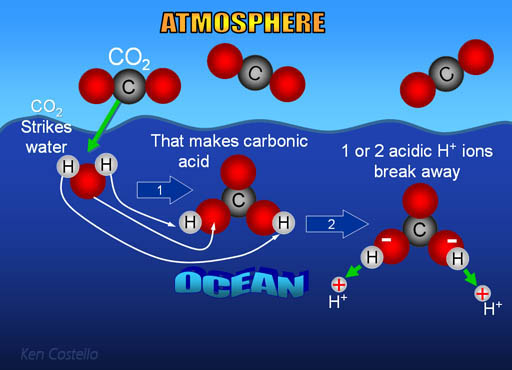
Some factors that we can control to prolong earth’s life sustaining abilities are the amounts of pollution and deforestation and energy that we use. If we control the amount of energy that we use a bit more, maybe we could lower pollution levels. I read in a popular science magazine that the oceans are actually absorbing the pollution from our cars and other appliances. Some may think that’s a good thing, that if it is out of the sky it won’t affect us. WRONG. The immense amount of carbon based pollution that is given off from our cars and homes is enough to change the pH balance of the ocean. When enough carbon is mixed with water, it becomes carbonic acid. In my opinion, if pollution is drastically decreased, the ocean might become acidic by 2050. I don’t think it will be enough to melt a swimmer’s skin off, but it will be enough to kill ocean life.
Another ocean problem that I want to briefly cover is dead zones. According to Jennifer Kennedy of marinelife.about.com, “A 'dead zone' is an area of low oxygen, where marine life can't thrive. The dead zone may be caused by an excess of nutrients (eutrophication) that results in a decrease in dissolved oxygen. The best example of a dead zone in the U.S. is the Gulf of Mexico dead zone, which occurs each year in the late spring and summer.”
But enough about earth’s problems, I want some solutions. For the long run, I think the only thing we can do is build a massive space ship, and put select members of the human race into it to pass down only the best genes that will be necessary for life in space. I don’t think we should just fly around in circles like idiots in space though, we need to find another planet that can sustain complex life.
Gliese 581 d, may be that planet. “New measurements of the planet's orbit place it firmly in a region where conditions would be right for liquid water, and thus life as we know it, astronomer Michel Mayor, from Geneva University in Switzerland.” This is a pretty exciting discovery, but one huge problem with Gliese 581 d is that it is over 20 light years away which is about 120 TRILLION miles.

http://www.youtube.com/watch?v=H5zSWQwpjPg&NR=1
Great video about traveling to Gliese 581 d.

The narrator of this video said that a journey to gliese 581 d on the fastest man made object, Voyager 1 which travels through space at a brisk 11 miles per second would still take over 350,000 years. However, knowing the flaws of the human race, it would not take 350,000 years for something to go wrong on that ship. We need to advance our technology so that one day we could travel at or faster that the speed of light. A twenty year trip doesn’t seem so bad when the other option is a 350,000 year trip.


Sunday, November 20, 2011

The Great Wall and the Great Vacuum


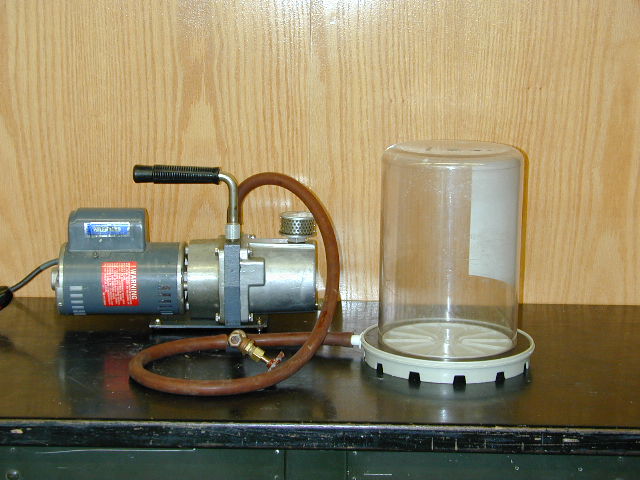
Thinking of something to build over the summer, I thought it would be cool if I could build a vacuum chamber. How could I build something like that?

While seeing that it requires many gauges, pumps, and nozzles, I realized that I didn’t really want to build one even though it would be a cool project in the end. Besides, what would I do with a vacuum chamber? Anyway, I had put a lot into thinking about what it would take to build a vacuum chamber as efficiently as possible. The container would have to be very sturdy and solid so that it would not give way to the intense suction inside the chamber. The solidity and strength of the material that made the chamber would have to withstand the pressure of atoms wanting to go from higher concentration outside to lower concentration inside the chamber, or diffuse.
(cellular) Diffusion
Then as I kept thinking about what it would take to build a vacuum chamber, I started to think about the biggest vacuum chamber of all, space.
As I mentioned in my last blog post, Membrane Theory, there is not just one universe, what we live in is a multiverse, with millions of universes in it. I also mentioned that a “Big Bang” happens when walls of a universe collide and send strings of matter out into each universe in a violent, hot instant. That would mean that the universe has an end! In our unfathomably large universe there is a wall that separates outside from inside. If you think about it, of course there is, because if there was no wall separating outside the universe from inside the universe we wouldn’t have a vacuum. Even if we didn’t already know that we live in a multiverse and that the big bang happened from walls of universes colliding it would make sense to think that the universe needs a barrier to keep in the matter. If the universe didn’t end, and was infinite, that would be another story. If there was an infinite amount of space and the same amount of matter that we know exists, wouldn’t the vacuum be stronger? Think of it like pulling back on a syringe that is clogged at the end it takes air in. It would get harder and harder to pull back because the negative pressure would get more and more intense.
Wouldn’t the power of the vacuum be strong enough to rip atoms away from each other and counteract the effects of gravity if the universe were infinite?

http://www.youtube.com/watch?v=OHY9fFQhX68&feature=related
Video of marshmallows in a vacuum chamber

In this video, the marshmallows expand as the pressure decreases then when pressure increases again, the marshmallows shrink back down into normal size. This is a great model of what happens to anything as pressure increases or decreases. The increase in pressure would put more weight on each part of an object, lets say a marshmallow, and push every part of it uniformly to create a more compact marshmallow. If pressure decreases the marshmallow is pulled evenly on all sides to make a puffier, larger mushroom with a lot more empty space in it.

Therefore, one of the reasons we are able to have stars and planets and gatherings of matter in our universe is that the vacuum’s pressure is just right to allow for gravity to bring gas into a dense cloud until the friction among atoms causes ignition. The pressure is also just right enough to allow gravity to make planets. And thanks to the very sturdy wall of our universe that not only collided with another to cause the big bang and give us all the matter we know of, but also acts as a great barrier to keep in our matter and keep us at the perfect pressure.


Sunday, November 6, 2011

Membrane Theory

Although gravity may seem to be a force overcome with strength for keeping the world orbiting around the sun or drawing massive bodies close to one another, it is actually quite feeble. Every day we walk, jump and easily circumvent gravities pull. One way to show how weak gravity is is by putting a paper clip on a counter top and using a magnet to pull the paper clip through the air and up onto the magnet. Even a small magnets electromagnetic force can easily circumvent gravity. Think about the strong force of atoms.
(1)(2) 
Image (1) from
Image (2) from
http://physics.bu.edu/cc104/proton_repel.gif

The strong force holds protons and neutrons together with so much force that when we use unstable atoms to give protons the energy they need to escape strong force’s grasp we get an atom bomb. The electromagnetic force means that like charges repel. So ++ and -- repel. The strong force is what keeps the protons in the nucleus.             
                Why though is gravity so weak? String theory states that all matter is made up of tiny vibrating strings. A more recent development in string theory was that our universe is many strings conjoined and connected to make one huge, moving membrane. This addition to string theory became known as membrane theory, or M theory. Well, thanks to string theory we know that there are eleven dimensions in the universe. Some are so small that they are trillionths of millimeters across.
Image of many conjoined strings in a large rippling membrane 
Image from

         Some scientists had a thought that gravity was being diluted into all of these dimensions. But others thought that maybe gravity wasn’t being diluted within our universe, maybe gravity was leaking into our universe. In a parallel membrane, or universe, gravity would be as strong as the other forces, but by the time it reached us it would be a fraction of what it used to be. Physicists started to get behind this idea and did the math to prove that parallel universes were leaking gravity into our own and they found that the math worked. Scientists were finding more and more parallel membranes which were taking on many different shapes and sizes.
           The universes rush around, filled with energy. The membranes will often collide with considerable force and since they are made of the tiny strings that are vibrating, they membranes could collide at different places and at different times, rippling into one another violently. This would release tremendous amounts of energy in a big bang. The tiny strings would be ripped out of the membrane and shot into the empty universe and the strings would want to come back together. When they did meet again, they created matter. The ripples of the membranes that hit at different points at different times give explanation to clumps of matter in the universe. If the membranes didn’t ripple and were flat, all matter in the universe would be clumped together from the start. Thanks to the ripples the matter was spread out just right. Another phenomenon that may have happened during the collision is that forces from one universe may leak into the other very rapidly. Therefore, gravity from another universe may have spilled into ours.

Image shows rippling membranes about to collide

           There could be universes out there that have laws that are nothing like the laws of physics of our own universe. There is an infinite number of parallel universes which means that there is an infinite number of universes that can support inelegant life. So, there could be parallel universes out there that are exactly the same as ours, the only difference being, you are not there.
 (I apologize to all of my readers for having a bad picture to word ratio in this post. There are not many pictures that portray Membranes well because it is a relatively new theory and is hard to put into picture form.)